
If you're running a company out of the Dallas Medical District, the West End, or the Richardson corridor, AI is already reshaping your competitive landscape. Supply-chain firms are using predictive routing. Fintech companies are automating risk assessments. The leaders who figure out how to turn AI into a revenue-driving capability — not just a costly experiment — are the ones pulling ahead.
Key Takeaways
- Focus on AI solutions that integrate your proprietary data and scale beyond off‑the‑shelf tools.
- Prioritize partners with deep expertise in specific sectors (logistics, healthcare, real estate) and a track record of delivering routing, clinical automation, or pricing models.
- Choose local firms for their regulatory knowledge and operational insight that national vendors often lack.
- Evaluate partners on domain fluency, transparent methodology, and measurable, outcome‑driven results rather than buzzwords.
- Require a short‑term pilot (60‑90 days) to validate ROI and feasibility before committing to full‑scale deployment.
What AI Development Means for DFW Business Owners
When most DFW business owners think about AI, they're picturing tools — ChatGPT, Copilot, or an off-the-shelf automation platform.
Those tools solve general problems, but they weren't built around your workflows, your data, or your market.
Custom AI development starts where those tools stop, engineering systems that operate on your specific business logic and deliver measurable outcomes.
Our team can deliver a deterministic data pipeline that pulls from your existing data sources, processes them in real time, and feeds outputs directly into the tools your team already uses.
AI Tools vs. Custom AI Development
Most DFW business owners encounter AI through tools — Copilot, ChatGPT, HubSpot's AI features, or any number of plug-and-play platforms promising instant productivity gains.
These tools work — until they don't.
Custom AI development in Dallas addresses what off-the-shelf platforms can't:
- Business-specific logic — your pricing models, compliance requirements, and operational workflows built directly into the system
- Proprietary data integration — connecting internal databases, CRMs, and industry platforms that generic tools can't access
- Scalable architecture — infrastructure designed to grow with your operations, not around a vendor's limitations
When you work with an ai consulting firm, you're not configuring software — you're engineering a solution.
That distinction matters.
AI development Dallas businesses actually benefit from is purpose-built, not repurposed.
Why Dallas Companies Are Turning to AI Right Now
The industries powering DFW's economy aren't adopting AI out of curiosity — they're doing it because operational pressure and competitive exposure have made the decision unavoidable.
Real estate, logistics, healthcare, and finance each face distinct data volumes, compliance demands, and margin constraints that make manual processes increasingly expensive to defend.
Understanding where AI is gaining traction in each of these sectors gives you a clearer picture of where the technology delivers measurable returns versus where it's still maturing.
Healthcare revenue cycle teams benefit from AI-driven claims automation that reduces manual workload and ensures HIPAA compliance.
Industries Driving AI Adoption Across DFW

Dallas isn't adopting AI because it's trendy — it's adopting it because the economics make sense. The industries anchoring DFW's economy are generating the exact conditions where AI delivers measurable returns. AI company businesses are partnering to understand these sector-specific pressures firsthand.
Three industries are leading adoption:
- Real estate — AI models analyze pricing, absorption rates, and development risk across one of the nation's most active property markets.
- Logistics — DFW's distribution infrastructure creates dense routing, forecasting, and warehouse optimization opportunities that AI solves efficiently.
- Healthcare — Large regional systems are automating clinical documentation, scheduling, and claims processing to reduce overhead.
If your business operates in any of these verticals, you're not early to AI — you're already behind the curve.
Local vs. National AI Firms: What DFW Leaders Should Know
When you're evaluating AI partners, the firm's geographic context matters more than most DFW leaders initially expect.
A national agency brings broad technical capability but often lacks the market-specific intelligence that shapes how AI solutions actually perform in Dallas-Fort Worth's dominant industries — real estate, logistics, healthcare, and finance.
A local firm that operates inside this economy daily builds systems calibrated to the regulatory environment, vendor ecosystems, and operational rhythms your business already runs on.
The Advantage of a Firm That Knows DFW
Something gets lost when a national AI firm parachutes with a generic solution built for no market in particular. A local firm brings contextual knowledge that directly shapes build quality:
- Industry fluency — We recognize that a Dallas logistics company operates under BNSF corridor constraints, not generic supply chain assumptions.
- Regulatory awareness — DFW healthcare and finance clients face specific Texas compliance requirements that out-of-state teams routinely underestimate.
- Relationship proximity — When your system needs adjustment, you're not filing a ticket with a team three time zones away.
You're not just buying code. You're buying judgment shaped by years of working inside DFW's actual business environment. That context makes your AI solution measurably more effective from day one.
What National Firms Miss About Local Business Culture
National AI firms optimize for scalability, not specificity — and that distinction matters more than most DFW leaders realize. Their models get trained on broad datasets, their workflows get designed for replication across dozens of markets, and their account teams rarely understand the operational rhythms that define your industry locally.
They don't know that Dallas commercial real estate moves differently than New York's. They haven't tracked how DFW logistics networks absorbed the volatility of the past few years. They can't anticipate how Fort Worth's healthcare procurement cycles actually function.
That knowledge gap produces AI solutions that technically work but don't fit — systems you'll spend months adjusting after deployment. A firm embedded in this market builds that context in from the start, not as an afterthought.
Choosing the Right AI Development Partner in Dallas
When you're selecting an AI development partner, technical capability alone won't determine your outcome — business understanding will.
The right firm translates your operational challenges into engineered solutions, not generic demos.
Knowing what separates a capable partner from a costly mistake starts with recognizing the red flags before you sign a contract.
Consider a partner that offers custom LLM integration to ensure solutions are tailored to your specific needs.
Not sure where to start with AI in Dallas?
We'll tell you honestly if we're the right fit — and if we're not, we'll point you in the right direction.
Schedule a Free ConsultationTechnical Expertise vs. Business Understanding
Choosing the right AI development partner comes down to a distinction most business leaders don't recognize until it's too late: technical expertise and business understanding aren't the same thing, and you need both.
A technically strong team that doesn't understand your industry will build solutions that work in theory but fail in practice.
Evaluate partners against three criteria:
- Domain fluency — Can they speak intelligently about your industry's workflows, compliance requirements, and data structures?
- Problem framing — Do they diagnose your business problem before proposing a solution?
- Outcome orientation — Are they measuring success by model performance or by business impact?
In DFW's real estate, logistics, healthcare, and finance sectors, the gap between those two skill sets costs companies time, money, and competitive ground.
Red Flags to Watch Out For
Knowing what to look for in a partner is only half the equation — knowing what to walk away from matters just as much.
Watch for firms that can't explain their methodology without retreating into buzzwords. If they can't articulate how their models handle your data, that's a problem.
Be skeptical of vendors who pitch off-the-shelf tools as custom solutions — repackaged software rarely fits the operational complexity of DFW's logistics corridors or healthcare networks.
Avoid partners who skip discovery and move straight to proposals. That shortcut signals they're selling, not solving.
Also flag any firm that can't produce verifiable case studies from comparable industries. In a competitive market, vague promises and portfolio gaps aren't just inconvenient — they're expensive.
How to Start With AI Without Wasting Your Budget
Before you commit capital to a full AI build, test your assumptions with a scoped pilot project targeting a single workflow or decision point.
A pilot lets you validate data quality, user adoption, and ROI potential at a fraction of the cost — before those variables become expensive problems.
If the pilot holds up under real operating conditions, you've earned the confidence to scale; if it doesn't, you've protected your budget from a much larger mistake.
Pilot Projects vs. Full Builds
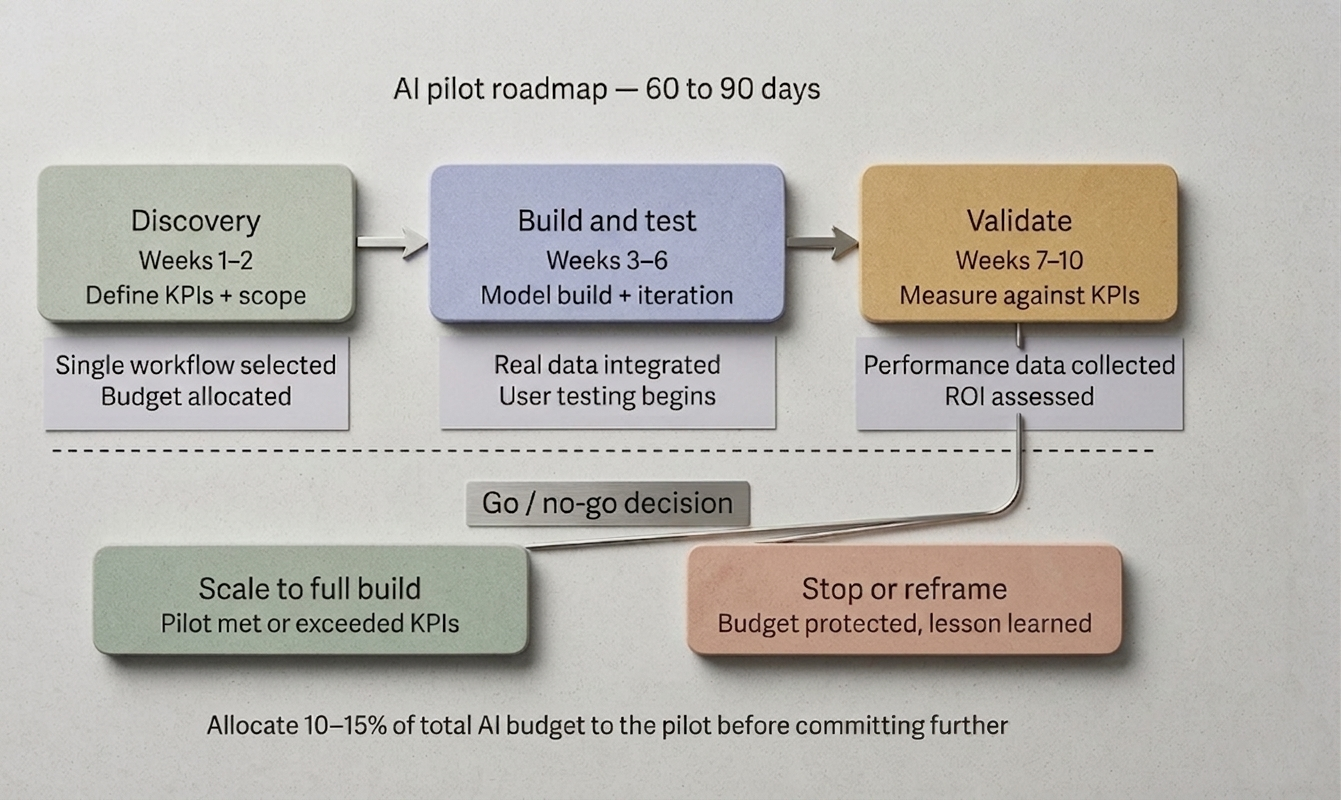
Most DFW businesses that stumble with AI don't stumble on the technology — they stumble on the scope. Before committing to a full build, validate your use case with a structured pilot.
A well-scoped pilot should:
- Target one workflow — pick a single, measurable process like invoice reconciliation or lead qualification, not an entire department.
- Run 60–90 days — long enough to generate real performance data, short enough to contain risk.
- Define success upfront — establish concrete benchmarks before development starts, not after.
If the pilot delivers, you scale with confidence. If it doesn't, you've spent a fraction of a full build budget and you've learned something actionable.
In Dallas's competitive business environment, that discipline separates companies that adopt AI effectively from those that abandon it expensively.
Conclusion
Your next move determines whether you stay ahead of the market or fall behind competitors who already have AI embedded in their operations. A Dallas‑based AI partner brings more than proximity—they bring intimate knowledge of DFW’s industry rhythms, regulatory nuances, and the local business culture that drives decision‑making. They speak your language, share your community ties, and can translate AI into measurable results on your own terms. The choice isn’t about a distant vendor; it’s about a teammate who lives and works in the same ecosystem, ready to align technology with your strategic priorities right now.