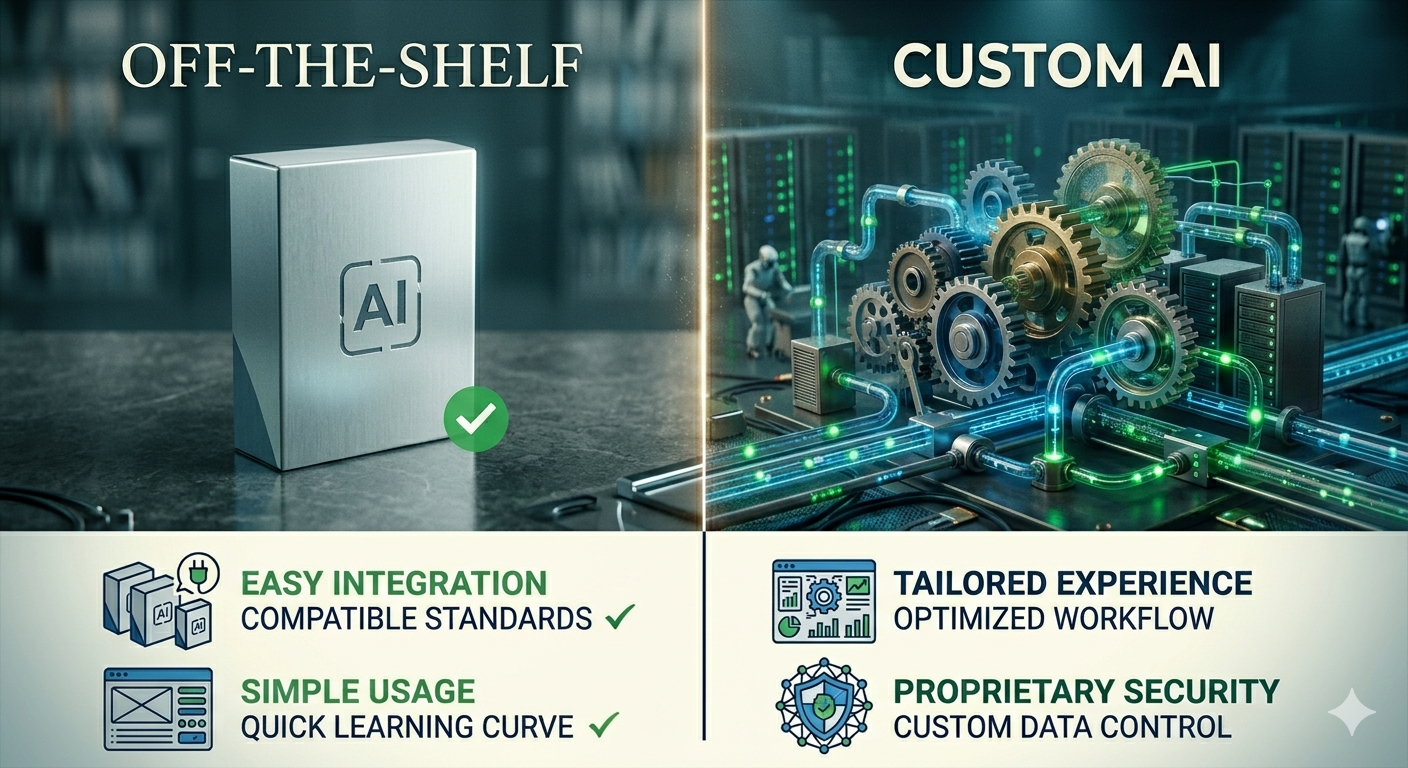
Most VPs of IT assume the only choice is "build or buy," but at 42 Robots AI we'll be blunt: the answer is almost always custom — and the question worth asking is whether your problem is simple enough to be the exception. The decision hinges on four concrete criteria — how unique your data really is, how complex the underlying processes are, whether the AI creates a sustainable competitive advantage, and how much you're willing to commit to ongoing maintenance. Miss any of these, and you'll waste budget on an off‑the‑shelf product that quietly throttles growth, or commit to a custom build before you've done the diagnostic work to justify it. The facts that matter to your bottom line have nothing to do with hype — they have to do with your data, your workflows, and your team's capacity to maintain what you build.
Key Takeaways
- Data uniqueness — If your organization's data contains proprietary terminology, custom formats, or rare patterns, you need a solution trained on that specific corpus. Off-the-shelf models work fine on generic text but miss the nuances that give your business its edge.
- Process complexity — When workflows involve multi-step reasoning, conditional logic, or integration of several data sources, a custom model can be engineered to handle those dependencies. Simple, linear tasks are often satisfied by ready-made APIs.
- Competitive advantage — Deploying a custom AI that only you possess can create a defensible moat. If the same model is publicly available, competitors can replicate the experience, turning the technology into a liability rather than a differentiator.
- Maintenance commitment — Custom models require ongoing data curation, monitoring, and model updates. Your organization must be prepared to allocate resources for continuous improvement — otherwise a managed off-the-shelf service will keep the system stable with minimal overhead.
When Off‑the‑Shelf Applies
Off-the-shelf is a narrow exception, not a default option. It applies when:
- The problem is genuinely simple — basic document processing, standard scheduling, or common customer support automation with no edge cases
- Your data looks like everyone else's data and contains nothing proprietary
- There is no competitive stake in how the AI performs
That's a short list on purpose. The moment your problem introduces any meaningful complexity — variable document formats, industry-specific terminology, multi-step workflows, compliance requirements — off-the-shelf stops being a reasonable choice. It isn't just a performance gap; it becomes an operational liability.
When custom AI is worth the investment
Custom AI is more targeted, more reliable, faster to run, and less expensive to operate at scale. The setup cost is higher — but in virtually every case beyond the simplest problems, that investment pays back quickly.
- Your data is unique enough that generic models produce poor accuracy or miss critical terminology
- The workflow is complex, requiring custom pipelines, domain‑specific reasoning, or strict compliance handling
- You need capabilities that cannot be replicated by off-the-shelf tools
- Your team is ready to commit resources to ongoing model maintenance, monitoring, and iteration
Why the Build vs. Buy Question Is the Wrong Starting Point
Most companies walk into an AI decision already asking the wrong question.
"Should we build or buy?" sounds strategic, but it skips the step that actually matters: understanding what problem you're trying to solve and whether AI is even the right tool for it.
The build vs. buy AI framing assumes you've already done the hard diagnostic work — clarifying your workflows, identifying your data gaps, and defining what success actually looks like.
Most organizations haven't.
The real starting point is understanding your operations with enough precision to know which path fits. That is exactly what our AI Strategy and Assessment process is designed to answer — before anyone commits to building anything.
For most problems, custom AI is the right answer. The diagnostic work exists to confirm that — and to catch the rare cases where it isn't.
Getting that diagnosis right first changes everything that follows.
The Four Criteria That Actually Drive the Decision
We often start the conversation by asking whether to build or buy, but that framing clouds the real factors that matter.
The decision should be guided by four concrete criteria: data uniqueness, process complexity, competitive advantage, and maintenance commitment.
If all four point toward a generic solution, off-the-shelf may apply — but that alignment is uncommon outside of truly simple use cases. When they point to a need for differentiation and control, custom AI isn't just justified — it's the more economical choice over the long run.
In healthcare revenue cycle management, we saw how those criteria led to a custom solution that delivered measurable gains.
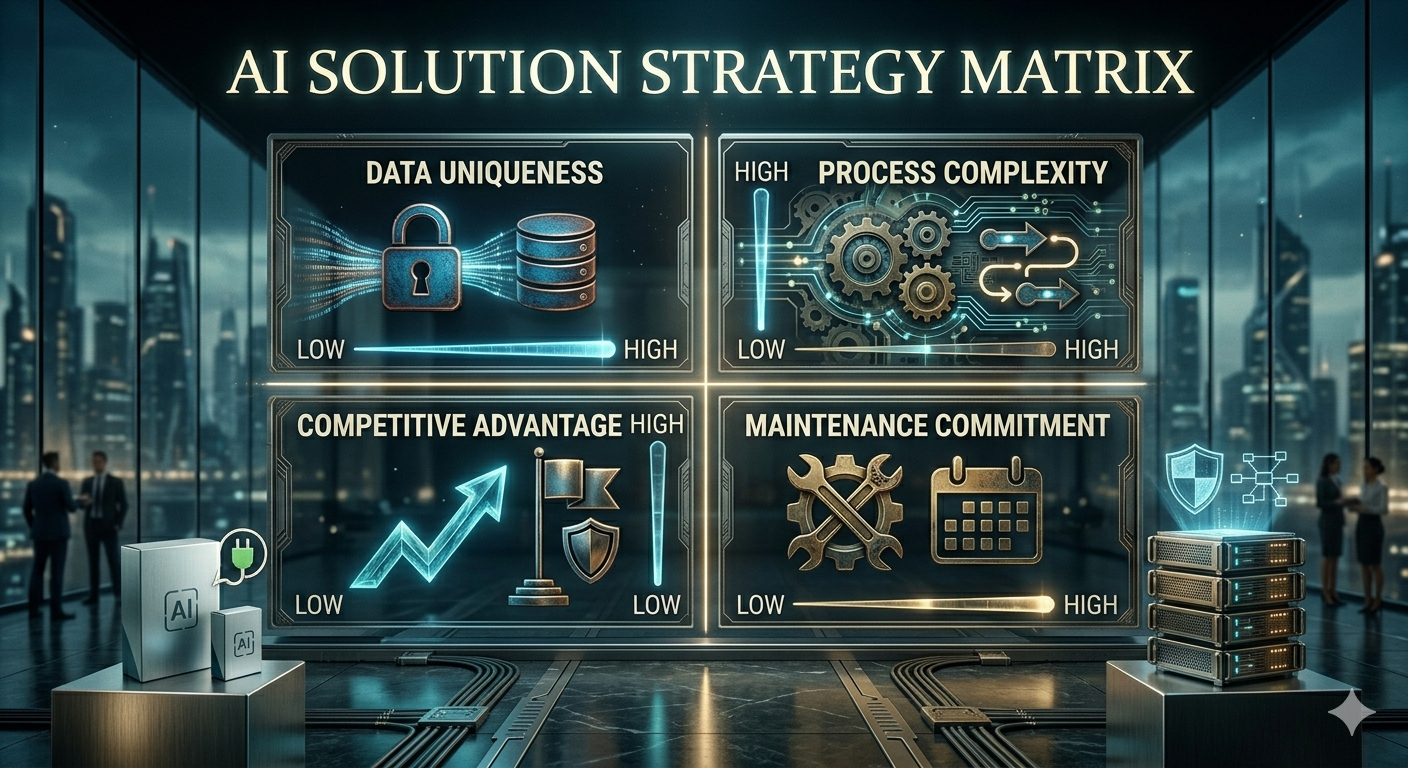
Data Uniqueness — Does Off-the-Shelf Even Understand Your Data?
How unique is your data? That question drives the entire custom AI vs. off-the-shelf decision more than any other factor. Generic tools are trained on generalized datasets — they're built for the average case, not yours.
"The first question we ask is: how unique is your data? Generic AI tools are built for the average case.
If your documents, workflows, or terminology are specific to your business — a generic tool will give you generic results at best and compliance failures at worst."
Ask yourself three things:
- Does your data include industry-specific terminology or formats?
- Do your documents vary considerably in structure?
- Are there compliance requirements tied to how your data gets processed?
Score yes on all three — off-the-shelf won't hold up.
Process Complexity — How Many Edge Cases Does Your Workflow Have?
Data uniqueness tells you whether AI can understand your inputs — process complexity tells you whether it can handle what comes next. Off-the-shelf tools are built for standardized, short-term needs.
If your process has a long tail of edge cases — data that varies widely, industry-specific jargon, documents that no two look the same — you're going to spend more time working around the tool than using it. That's when custom makes sense.
Map your workflow honestly. Count your exceptions. In healthcare and finance especially, "exceptions" aren't rare — they're routine.
When your edge cases are frequent and varied, a generic tool doesn't just underperform; it creates operational risk. Custom AI is designed around those exceptions from the start, not patched around them after the fact.
Competitive Advantage — Is AI Core to How You Win?
Ask these questions honestly:
- Can your competitors purchase the same tool tomorrow?
- Does your AI touch customer-facing decisions or revenue-generating workflows?
- Is your differentiation built on how you process proprietary data?
If you answered yes to most of those, a generic platform isn't just limiting — it's a strategic liability.
Maintenance Commitment — Who Owns It After Launch?
With off-the-shelf tools, the vendor handles upgrades, patches, and performance monitoring. You pay a predictable subscription and inherit their roadmap.
Custom AI flips that equation. You own the system — which means you own the maintenance, the monitoring, and the troubleshooting.
That requires either internal technical capacity or an ongoing development partnership. Many organizations underestimate this total cost of ownership.
"Custom AI is not a one-time project. It needs to be maintained, monitored, and updated as your data evolves. We tell every client this before we start. If your organization is not ready to own that, off-the-shelf is the more honest choice."
If you can't commit to it, don't build it.
When Custom AI Development Is Worth the Investment
Once you've confirmed the fit, the calculus is clear — and the bar for custom isn't as high as most organizations assume.
Watch how we walk through the custom AI decision in practice — including the trap most organizations fall into:
That's the threshold. When your data is proprietary, your processes are complex, and AI is core to your competitive advantage, custom earns its cost.
Consider Janus Health — thousands of daily faxes, handwritten medical billing data, no two alike. A custom hybrid system delivered a 99% automation rate and $4 million in savings. That's when custom is clearly the right call.
A Real Example: Healthcare RCM
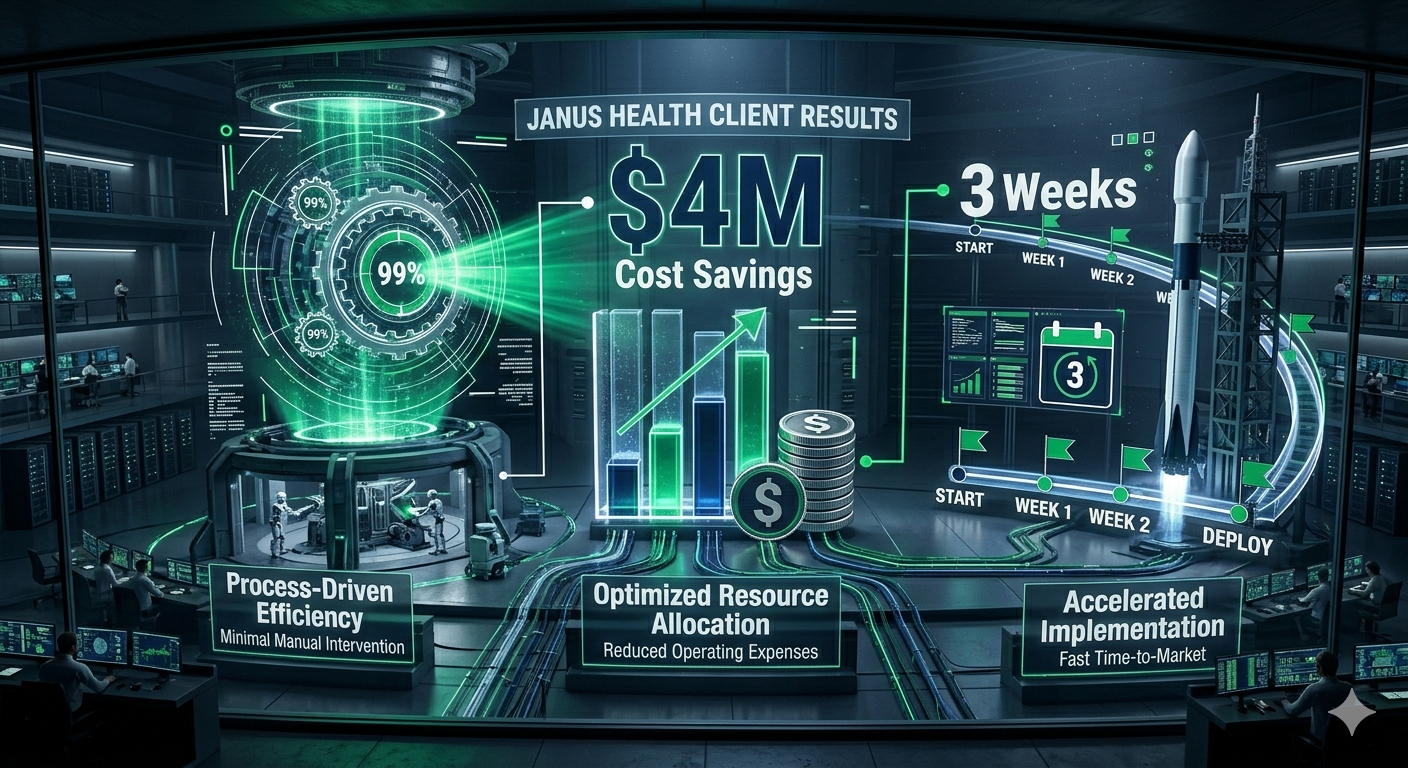
The Janus Health engagement makes the decision framework concrete. They processed thousands of faxes daily — handwritten medical and billing documents where no two looked the same. Off-the-shelf tools failed immediately.
We built a hybrid AI system combining deterministic code with targeted machine learning. The results:
- 99% automation rate on a document type that generic tools couldn't reliably parse
- $4 million in cost savings driven by eliminating manual processing at scale
- First deployment in three weeks — fast enough to prove value before full commitment
Janus scored high on every criterion: unique data, complex process, direct competitive advantage, and a team ready to maintain it. That's when custom isn't just justified — it's the only logical choice.
The honest answer hinges on four things: your data, the complexity of your workflow, the competitive edge you need, and how much you're willing to invest in ongoing maintenance. For most problems with any real complexity, custom AI is the more targeted, more reliable, and ultimately more cost-effective path. Off-the-shelf is a reasonable starting point only when the problem is genuinely simple and the stakes are low.