Stop building AI agents. Build AI-powered systems instead.
For the past several years, AI agents have been one of the most hyped ideas in the industry. The pitch goes like this. Everything will be an agent. Not one agent, but agents connected to agents, a whole swarm of them talking to each other.
There is real value in agents for some problems. But agents are not the whole answer, and for a lot of problems they are inefficient and suboptimal. The bigger issue sits underneath the agent hype: putting the AI model at the center of the solution. I think that's the biggest mistake people make when building AI solutions.
Many AI Solutions Need Zero AI Agents
I've built solutions for companies that saved them millions of dollars and added real value, with zero AI agents. Here's one example from healthcare.
The better frame is AI-powered systems, or AI-powered software. That sounds like a small distinction. It opens up a lot of doors.
Calling something an agent implies it needs some amount of chat. Every agent also carries overhead. In a solution with ten agents, every interaction between them adds waste, especially when you didn't need that type of agent for that job.
Plenty of tasks don't need chat at all. They need AI to extract some data, transform some data, move some things, or semantically analyze something. None of that requires a conversation. Using chat for it wastes tokens and makes the whole system less reliable.
The Biggest Mistake When Building AI Solutions
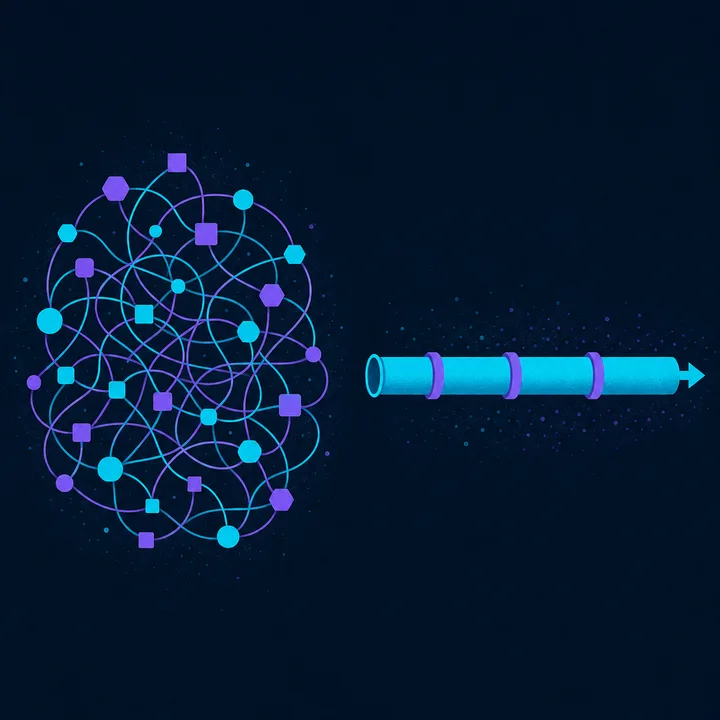
The industry has settled on a structure for AI solutions that is suboptimal from several angles. The model sits at the center and does as much of the work as possible. Almost 90% of the solution is the LLM on a loop, trying to solve the problem over and over. Everything else is window dressing, also known as a harness.
That works reasonably well for some use cases. For most use cases, it is extremely suboptimal. It hurts you three ways.
- Reliability drops. This is the most important one.
- Cost goes up.
- Speed goes down.
I believe this structure is a big reason so many companies struggle to get real value out of AI, and why so many AI projects fail.
It's also worth asking who benefits. When you put an LLM on a loop and let it grind, you spend way more tokens. The model companies love that.
Flip It: Software at the Center, AI Where Only AI Works
The better approach flips the structure on its head. Put the system at the center. In my case that's usually the software, the non-AI part. Pull as much of the solution as possible out of the AI model. Then give the model only the small pieces that nothing else can do.
This still enables new solutions. Even if only 20% of a solution is AI, it can be a solution that couldn't be built without AI.
At each step you ask the AI to do less. That gets you a much more reliable output at each step, and you spend fewer tokens. Using tokens to do what regular old Python, C, or C++ code would do is just wasteful.
Randomness matters too. Many systems shouldn't have randomness injected at all. Even a 5% chance of a step going in the wrong direction is not good. Think about healthcare or banking. There are steps in those processes you don't want AI doing.
What you get in return
The trade-off is more engineering work. This is closer to classic software engineering. Break the problem into smaller pieces, then solve each piece. Solve each piece without AI if you can, because that makes it faster, less expensive, and more reliable.
The payoff is big. Built this way, you can get 99.9% reliability. Safety goes way up. It's faster, and it's way less expensive.
I've talked to only a few engineers at other companies who build this way. Their reaction is the same: yeah, that's just way better. In my opinion, this is how 95 to 99% of use cases and AI solutions should be built.
Three Signs an AI Vendor Is Selling Snake Oil
The same mistake shows up in how AI vendors sell. If you're looking at a vendor, watch for three signs.
1. The solution is completely AI-centric
They talk all about the models and the AI part, as if AI is 90% or more of the solution and the rest is just a harness. When I've solved real problems in businesses with AI, problems that couldn't be solved before, the majority of the solution was not AI. It tends to be about 20 to 60% AI. The rest is code and human-integrated systems that support the AI.
2. AI agents to the max
An agent here, an agent there, every task split into little agents talking back and forth. This dramatically reduces the consistency and reliability of the solution, because you depend too much on an LLM that generates random tokens. You also spend more tokens. The solution is less reliable and costs more.
3. Their messaging mirrors Silicon Valley
Your solution needs to be AI-centric. You need a bunch of agents. AI is going to solve all your problems.
AI can solve new problems that couldn't be solved before. That's true. Solving all problems is a huge leap. Large language models have fundamental issues that may or may not be solvable, despite years of promises. If a vendor sounds just like the top AI model companies, that's a red flag.
There are good AI vendors out there. These signs help you tell them apart.
How to Build Reliable AI Solutions
Before you build or buy, break the problem into pieces. For each piece, ask whether code can handle it without AI. Use AI only for the pieces where nothing else works, and keep each AI step as narrow as possible. Then measure every AI step with real AI evals, not vibes.
Frequently Asked Questions
Should every AI solution use AI agents?
No. Some solutions should use zero agents. Agents imply chat and add overhead, and many tasks such as extracting, transforming, or semantically analyzing data don't need chat at all.
What does it mean to not make AI the center of an AI solution?
Put deterministic software at the center and pull as much of the solution as possible out of the AI model. Give the model only the small pieces that code can't solve.
Why is an LLM on a loop a problem?
It reduces reliability, increases cost, decreases speed, and uses far more tokens than a system where code does most of the work.
How much of a real AI solution is actually AI?
In the business solutions David Hood has built, it tends to be about 20 to 60% AI. The rest is code and human-integrated systems that support the AI.
What are the warning signs of AI snake oil?
The solution is completely AI-centric, it uses AI agents everywhere, and the vendor's messaging mirrors what comes out of Silicon Valley and the top AI model companies.
This is how we build custom AI and LLM integrations at 42 Robots AI. If you want an honest read on an AI vendor or a solution design, reach out.