
Custom AI development typically takes 4 to 16 weeks, depending on your data quality, integration requirements, compliance needs, and project scope. Simpler AI automations can launch in under a month, while enterprise systems with multiple integrations or regulatory requirements can take several months. At 42 Robots AI, we've found that the biggest timeline differences usually come down to preparation. Teams with clean data, clear goals, and fast stakeholder feedback move significantly faster than teams trying to define requirements during development. In this article, we'll break down the five phases of a realistic AI project timeline, explain what slows projects down, and show what a real 3-week deployment looked like in the Janus Health case study.
Key Takeaways
- Most custom AI projects take between 4 and 16 weeks from discovery to deployment.
- Timeline length depends on project scope, data quality, compliance requirements, and integration complexity.
- Discovery and data readiness are usually the biggest factors affecting delivery speed.
- Projects move faster when stakeholders align early and success criteria are clearly defined.
- The five major phases are discovery, data assessment, MVP development, iteration, and production deployment.
- The Janus Health case study shows how a tightly scoped AI deployment reached production in 3 weeks.
The Honest Answer: Custom AI Development Typically Takes 4 to 16 Weeks
Custom AI development typically takes 4 to 16 weeks, and that range becomes much clearer when you break the work into a structured, five-phase roadmap.
From there, a real-world example like the Janus Health deployment shows how those phases actually play out in practice, including where timelines compress and where they expand.
That example also makes it clear which factors influence speed the most — especially data readiness and model iteration — and how those variables map directly onto different types of AI projects.
Once you understand those levers, it becomes easier to see how the same five-phase structure can produce very different timelines depending on scope and complexity.
Why the Range Varies So Much
When someone asks how long custom AI development takes, the honest answer is 4 to 16 weeks — and that range isn't vague, it's load-bearing. McKinsey's 2024 Global Survey on AI found most companies deploy gen AI within one to four months, with highly customized implementations 1.5x more likely to exceed five months — consistent with what we see in practice. Your AI project timeline depends on variables that compound quickly: data readiness, integration complexity, regulatory requirements, and how clearly your use case is defined before development begins.
A straightforward automation with clean data lands closer to 4 weeks. A multi-system custom AI development timeline involving model training, legacy API integration, and compliance review pushes toward 16.
Discovery and planning alone take 1 to 2 weeks when done right. Skip that foundation and you'll pay for it in rework.
How long does AI development take? Exactly as long as your complexity demands — not a day more, not a day less if the process is tight.
The 5 Phases of a Custom AI Project — and How Long Each Takes
Understanding the five phases of a custom AI project makes it easier to see where time is actually spent, what slows projects down, and why some deployments move significantly faster than others. Keep in mind that these timelines can vary depending on your specific use case, team readiness, and the complexity of the data involved.
Phase 1 — Discovery and Scope Definition (1–2 Weeks)
Before any building begins, you need a clear picture of what the AI actually needs to do — and that's what Phase 1 produces. You'll work with key stakeholders to identify the specific use case, define business goals, and establish measurable success criteria.
The deliverables are practical: a project scope document, a technical architecture proposal, and a clear definition of what "excellent results" looks like before work begins.
One to two weeks feels short, but a disciplined discovery phase prevents the scope creep and rework that quietly doubles timelines on poorly planned projects.
In many projects, we find the initial business problem is broader than what can realistically fit into a first deployment. Narrowing scope early usually speeds delivery more than adding engineering resources later.
Phase 2 — Sample Data Gathering (1–2 Weeks)
Once scope is locked, the work shifts to collecting real examples of what the AI needs to do. That means gathering sample inputs — the data, documents, requests, or signals the system will receive — alongside the corresponding outputs, meaning the correct results it should produce.
This isn't a formal data audit. It's a targeted collection effort focused on the specific transformation the AI needs to perform. The quality and representativeness of these samples directly determines how fast the build phase moves.
Gaps or inconsistencies in sample data surface here, before they slow down development.
Phase 3 — Build: Turning Inputs into Outputs (2–4 Weeks)
With real samples in hand, the build phase focuses on one thing: writing code and configuring AI that reliably transforms those inputs into the correct outputs.
This is not a traditional software sprint with a fixed spec. The samples define the target behavior, and the build is evaluated against them continuously. If the outputs aren't accurate enough, the team adjusts — model selection, prompting, logic, integration — until they are.
This phase ends not on a calendar date, but when the system produces results that meet the quality bar defined in Phase 1.
Phase 4 — Repeat: More Data, More Building, Better Results (1–4 Weeks)
Phase 3 rarely closes on the first pass. Real-world inputs expose edge cases, accuracy gaps, and failure modes that the original sample set didn't cover.
Phase 4 is the loop: gather more representative samples, refine the build, collect feedback from real users or operators, and repeat. Each cycle tightens the system's accuracy and reliability until results are consistently excellent.
This is where most of the quality improvement happens. Compressing or skipping this phase trades short-term speed for long-term production issues.
The number of cycles — and therefore the length of this phase — depends on how complex the transformation is and how quickly good feedback comes in.
Phase 5 — Production Deployment and Handoff (1 Week)
The final week is where development ends and operations begin. Your team runs security checks, executes final testing, and completes employee training — all within this single, compressed window.
APIs get locked down, permissions are confirmed, and integrations with your existing systems are verified against live data, not sandbox conditions.
This isn't a ceremonial handoff. It's a structured shift that determines whether your AI system actually gets used or quietly gets ignored.
Post-deployment monitoring is established before anyone walks away. That means performance baselines are set, alerting is configured, and a support structure is in place for issues that surface in the first operational days.
When this phase closes cleanly, your AI system stops being a project and starts being infrastructure.
The projects that succeed long-term are usually the ones that treat deployment as the start of operational monitoring, not the finish line.
What 3-Week Deployment Actually Looks Like: A Real Example
Our Janus Health case study reached first deployment in 3 weeks, with a 99% claims automation rate and $4M in cost savings.

The honest reality is that timelines vary widely, but breaking the process into clear phases shows where time is actually spent.
Once those phases are defined, the Janus Health case demonstrates how a 3-week deployment becomes possible in practice.
That example highlights the specific levers that accelerate or slow down implementation.
Understanding those factors makes the differences in project timelines much easier to interpret.
From there, a simple checklist helps translate the timeline into practical next steps.
Why Janus Health Hit Production in 3 Weeks
Four factors aligned on the Janus Health project that almost never align simultaneously — and that combination is what made a 3-week production deployment possible.
- Scoped MVP from day one — the team defined a tight, essential feature set during week one, eliminating scope creep before it started.
- Clean, existing data — high-quality datasets were already in place, cutting the data preparation phase dramatically.
- Pre-trained model foundation — building on pre-trained models instead of from scratch compressed training and implementation cycles considerably.
- Real-time feedback loops — testing ran concurrently with development, surfacing issues immediately rather than in a separate QA sprint.
When you bring all four of these to a project, timelines compress fast.
Miss even one, and you're likely looking at weeks of additional work.
What Accelerates Your AI Project — and What Slows It Down
The variables that separated Janus Health from a typical 12-week project apply to any engagement — here's how to control them.
Factors That Speed Up Delivery
When projects finish fast, it's rarely luck — it's usually a combination of clean data, a locked scope, and a client who can make decisions without a three-week approval chain.
Your timeline compresses when you bring the right inputs to the table from day one:
- Pre-trained models can shorten implementation cycles because teams are not building models entirely from scratch.
- A defined scope with clear success metrics keeps the team focused and prevents creep that bleeds weeks off the calendar.
- Stakeholder alignment upfront means roadblocks get cleared fast instead of sitting in someone's inbox.
Control these three variables, and you control your timeline.
Common Delays (and How to Avoid Them)
Most delays in custom AI development don't come from technical complexity — they come from organizational friction that was predictable from the start.
Dirty, disorganized data is the most common culprit. If your data isn't clean before the project kicks off, you'll spend the first half of the engagement just preparing it instead of building.
Integration bottlenecks are the second major drag. Internal approvals, undocumented APIs, and legacy system constraints can stall a project for weeks — sometimes longer than the build itself.
The third delay is misaligned expectations. Many AI projects stall during pilot phases because success criteria, ownership, and operational requirements were never clearly defined at the beginning of the engagement.
Fix these before kickoff: audit your data, map your integration dependencies, and define measurable success criteria upfront. Most delays are avoidable.
Timeline Estimates by Project Type
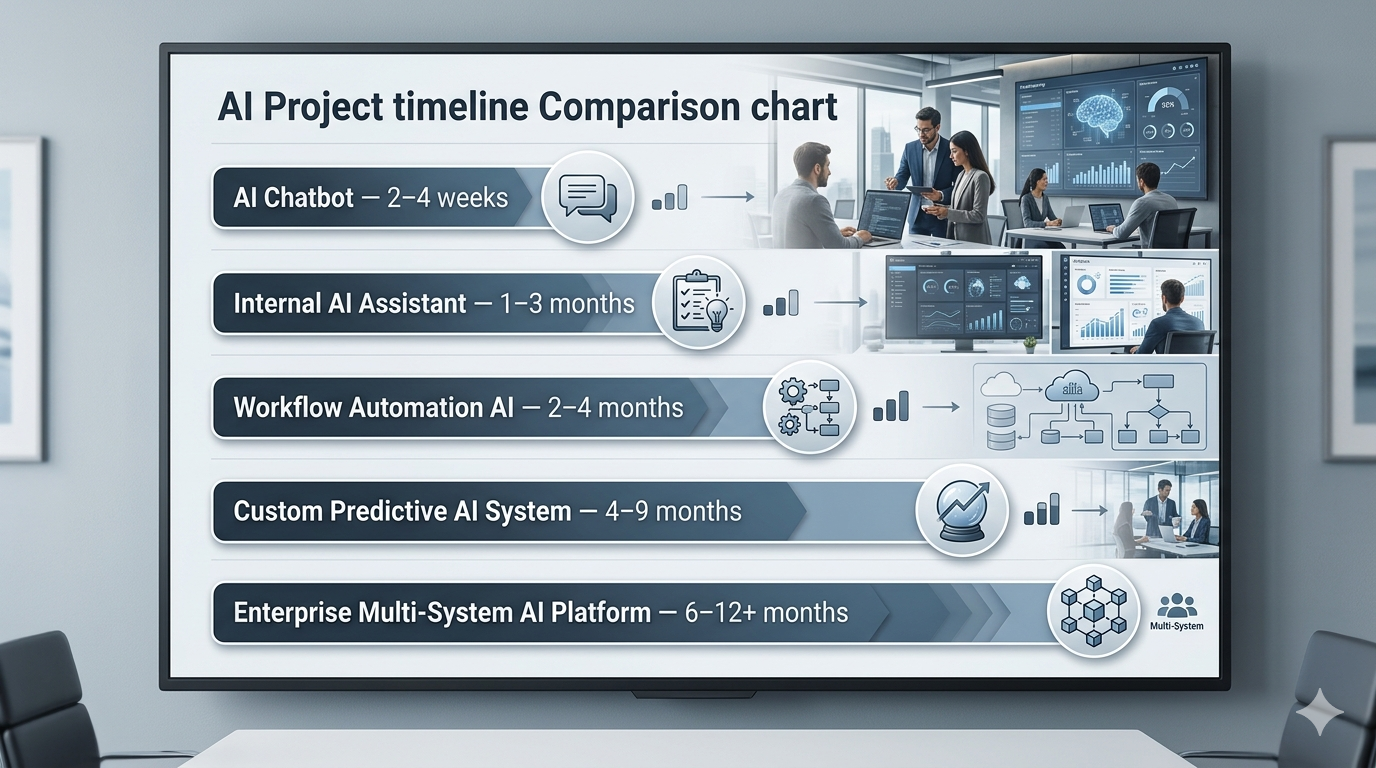
Not every AI project is the same, and the timeline shifts dramatically based on what you're actually building. Complexity, data readiness, and integration depth all determine where you land.
- Basic chatbots and simple automation: 4–8 weeks from kickoff to deployment
- Recommendation engines and mid-level systems: 2–4 months, largely driven by data integration and testing cycles
- Fraud detection and compliance-heavy systems: 6–12 months, due to regulatory requirements and deep infrastructure integration
- Data collection and preparation alone: 2–8 weeks, depending entirely on how clean and accessible your data already is
The pattern is consistent — complexity compounds time. If you're building something that touches regulated data, third-party systems, or requires model training from scratch, plan accordingly.
How to Get a Realistic Timeline for Your Project
The only way to get an accurate number is to go through a structured discovery process — typically 1 to 2 weeks — where you map your actual business needs, audit your data infrastructure, and define technical requirements.
Without that work, any timeline you hear is a guess.
Three variables will shape your answer more than anything else: how clean and accessible your data is, how many systems need to integrate, and how clearly you can define success before development starts.
If you want a number you can take to leadership, start with an AI strategy engagement.
That's what turns vague estimates into a defensible project plan.
Conclusion
A realistic custom AI development timeline depends less on hype and more on preparation, scope control, and operational alignment. Projects with clean data, clearly defined goals, and fast stakeholder feedback consistently move faster than projects trying to solve foundational issues during development.
Whether you're building a lightweight automation or a compliance-heavy enterprise system, understanding the five development phases helps set realistic expectations before work begins.