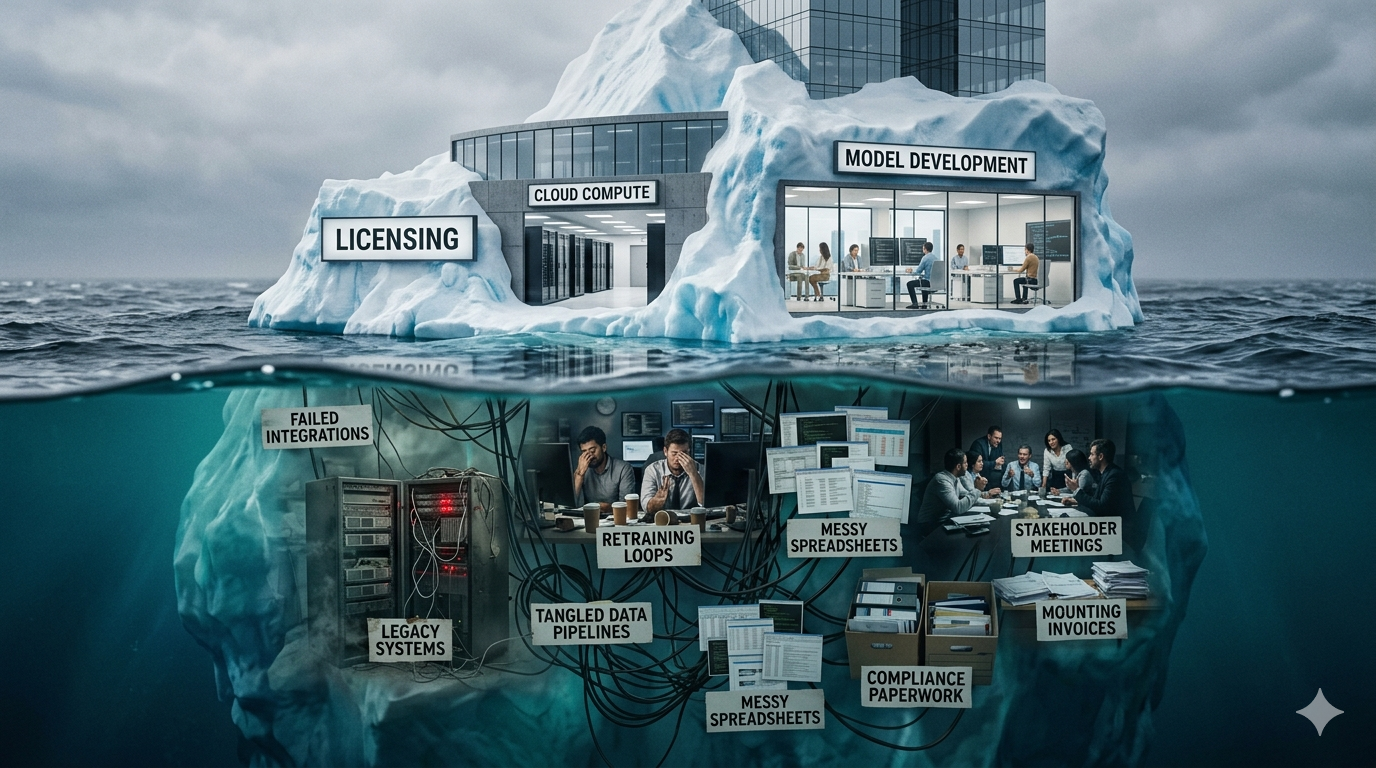
At 42 Robots AI, we know what it feels like to watch a seemingly solid AI initiative spiral out of control. We're an AI development company that tells clients the full price tag up front — including the cost of hiring us — so there are no nasty surprises later. In our experience, the single biggest hidden expense in AI project costs is building the wrong thing entirely. That disaster usually starts when organizations skip a thorough assessment phase and jump straight into development. You've probably already seen a vendor proposal that looked reasonable on paper, only to watch the project balloon once real work began. The hidden drains aren't the flashy data-pipeline upgrades or infrastructure upgrades; they're the wasted engineering hours, the re-work caused by misaligned expectations, and the opportunity cost of a solution that never fits the business problem. Below, we'll walk through the less-obvious line items that eat up budgets and share how to avoid them before they derail your AI initiative.
Key Takeaways
- Skipping an upfront discovery phase often means tackling the wrong problem, leading to cost overruns that can triple or quintuple original estimates.
- Data preparation typically consumes 50–70% of project time, yet budgets frequently omit it, resulting in significant overruns.
- Integrating AI solutions with legacy systems adds hidden time and budget that most proposals overlook until late in the project.
- Model drift monitoring, retraining, and other maintenance activities are ongoing operating expenses that can represent 15–30% of the original build cost annually.
- Investing in staff training and change-management programs is a necessary budget line, not an optional add-on — skipping it is one of the most common reasons technically sound AI projects fail to deliver value.
- Conducting a structured assessment up front surfaces these hidden costs early, preventing costly scope creep, integration surprises, and budget overruns later.
The Biggest Hidden Cost: Building the Wrong Thing
Before a single line of code gets written, most AI projects have already made their most expensive mistake — skipping proper discovery.
In practice, most organizations either don't know where to begin or they've defaulted to a broad general-purpose tool like Microsoft Copilot — and neither path leads to a solution built around their actual business problem. Without a proper discovery phase, there's no mechanism to close that gap before development starts.
Hidden AI project costs aren't just infrastructure or talent — they're the sunk costs of validating the wrong solution at production scale, where costs run 3–5 times higher than at proof of concept. Gartner predicts that over 40% of agentic AI projects will be canceled by the end of 2027 due to escalating costs and unclear business value — a failure pattern that starts long before a model is trained. When your AI development budget gets consumed correcting foundational mistakes, there's nothing left for the work that actually moves the business.
Discovery isn't optional. It's what keeps AI project costs from quietly spiraling before you've shipped anything. Our AI strategy and consulting services include a structured discovery phase by default for exactly this reason.
Data Preparation: The AI Project Cost Nobody Prices In Full
Even when a vendor's proposal looks thorough, data preparation is almost never priced in full. It typically consumes 50–70% of total project time, yet most AI consulting cost estimates bury or omit it entirely.
The numbers get specific fast. Data labeling runs $0.10 to $5.00 per data point — manageable at small scale, punishing at production volume. A 2024 survey by Precisely and Drexel University's LeBow College of Business found that 64% of organizations cite data quality as their top data integrity challenge, up from 50% the prior year, with 67% saying they don't completely trust their own data for decision-making. Poor data doesn't just slow projects down; it can invalidate a model entirely.
We've seen clean-looking datasets unravel during preprocessing. Inconsistent formats, duplicate records, missing fields, and unlabeled edge cases all surface after a contract is signed. If your vendor isn't scoping data preparation as a discrete, budgeted workstream, you're carrying hidden risk from day one.

Legacy Integration and Ongoing Maintenance
Connecting AI to your existing systems — CRMs, ERPs, custom internal tools — is consistently one of the most underestimated budget items in any AI project. Most legacy platforms weren't built with modern APIs in mind. Some have no APIs at all. Others have rate-limited or poorly documented ones that require custom connector work just to read data reliably. Our LLM integration work regularly surfaces these gaps during scoping that initial vendor proposals never mention.
Data formats between systems are another friction point. Legacy exports are often structurally inconsistent, requiring transformation layers before any model can touch the data. That work takes time, and time is billable.
Model Drift Is a Budget Item, Not a One-Time Fix
Deploying a model marks the beginning of ongoing operational responsibilities, not the end of them. Production inputs drift from training data constantly — user behavior shifts, business processes change, upstream data sources get updated — and when they do, model performance degrades quietly before it fails loudly.
Plan for these four recurring cost categories from day one:
- Drift monitoring infrastructure — covariate, label, and concept drift each require dedicated detection tooling
- Scheduled retraining cycles — proactive retraining costs far less than emergency intervention after accuracy has already dropped
- Data pipeline and API maintenance — the infrastructure that feeds your model needs ongoing support, especially when upstream systems change
- Compliance audits — regulated industries face mandatory model reviews that carry real resource costs
Industry benchmarks consistently put annual AI maintenance at 15–30% of the original build cost. For a $200,000 project, that's $30,000–$60,000 per year before you add a single new feature. Most vendor proposals don't include this line. Treat it as a permanent operating expense from the moment you approve the build budget.
Scope Creep and the People Costs Nobody Budgets For
Scope creep doesn't announce itself — it compounds quietly until your timeline has slipped by months and your budget is significantly over. The root cause is almost always a skipped or rushed discovery phase. You commit to a scope before you fully understand the problem, and then the build surfaces everything you missed.
The most common triggers we see in client projects: stakeholders request real-time features after a system was scoped as batch processing; additional data sources get added mid-build; testing reveals the training data doesn't cover enough edge cases to be production-ready. Each of these is a change order. None of them appear in the original estimate.
The people costs compound on top of this. Senior AI talent commands six-figure salaries and accounts for a significant share of total project budgets. Add onboarding time, internal training, and the productivity dip that comes whenever staff take on new tools and workflows, and you're funding a substantially larger project than you approved. McKinsey's Rewired research — drawn from more than 200 at-scale AI transformations — found that high-performing AI organizations are 3.6x more likely to redesign workflows and embed AI into actual business processes, rather than bolting models onto old habits. The gap between those organizations and everyone else isn't the technology. It's whether the people side was taken seriously.
A technically excellent AI system that nobody uses is still a failed project. Budget for the people side from the start, not after the model ships.
Understanding what AI consulting actually costs before you start is how you avoid approving the wrong number.
How We Map AI Project Costs Before You Commit
Before you commit a dollar to an AI project, we run a structured discovery process designed to expose costs that initial estimates almost always miss.
Here is what we surface in a discovery call — and why each item matters before you sign anything.
We start by auditing your data readiness, because data preparation consumes 50–70% of project time, and knowing your data's actual state before scoping prevents the most common budget shock. From there, we map the architecture between proof of concept and production: without deliberate planning from the start, that transition typically multiplies cost by 3 to 5 times. We then walk through every system the AI will need to connect to, since each legacy integration adds engineering cost that grows with the age and condition of the infrastructure. Finally, we plan for the operational load — budget 15–30% of total project cost annually for maintenance — so it doesn't get bolted on after the build is already over budget.

Our AI strategy and consulting services include this discovery phase by default.